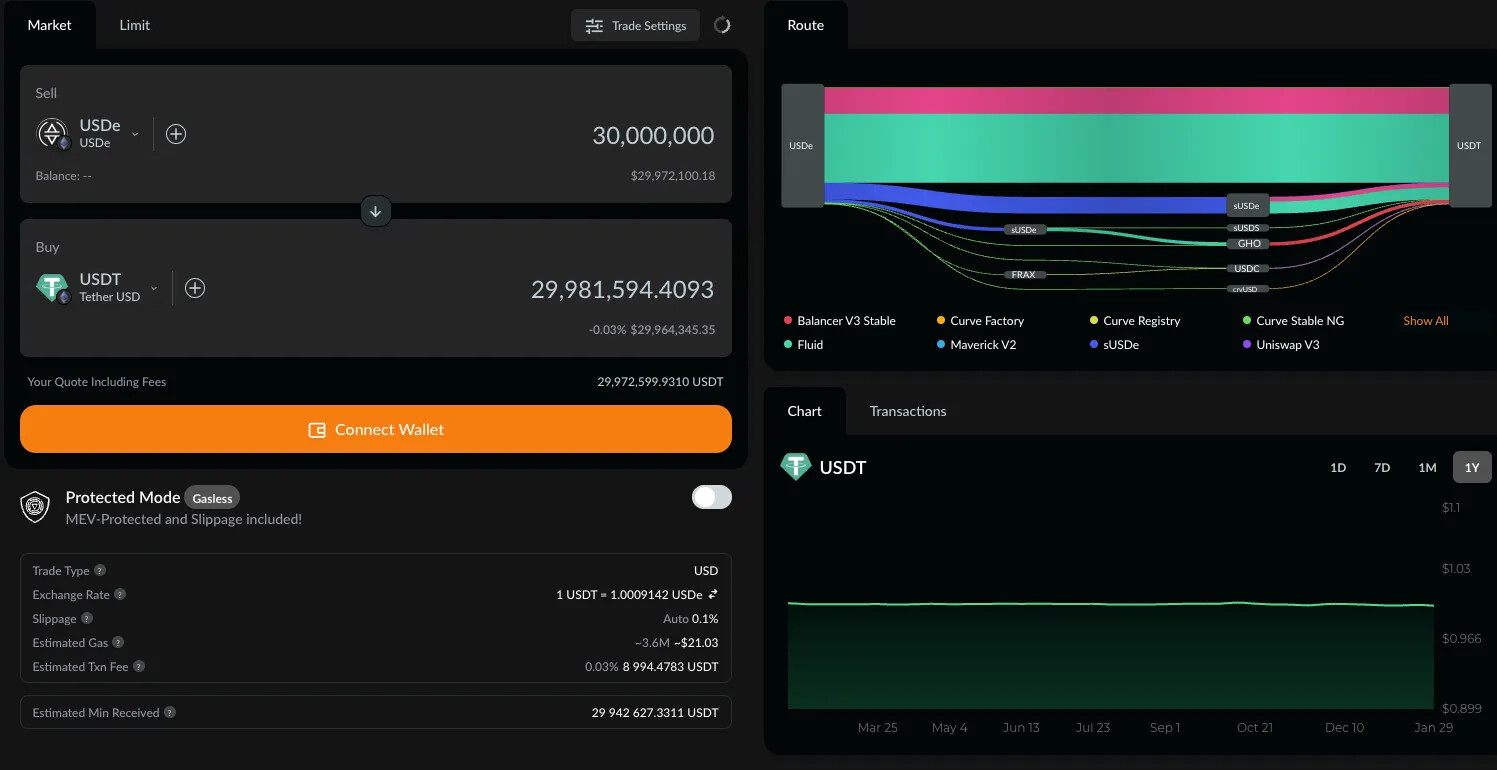
As expected, typical volatility is quite low; however, we must also consider moves under a depeg event. Assuming a maximum inter-block price drop of 2% and using the standard 5% buffer between LF and CF, we recommend setting the following risk parameters on both comets to balance capital efficiency with risk mitigation:
This one slipped by me, sorry for the belated feedback.
I’m aware that Ethena has been announced as a V4 partner and am broadly supportive of that agreement in principle, subject to the final design details and corresponding risk profile. However, one thing the deUSD debacle has made abundantly clear is that many depositors truly do not understand the nature of the collateral risk exposures they take on by the simple act of supplying into stablecoin markets. Many users across the forum and socials expressed genuine disbelief that their USDC or USDT deposit had exposed them in any way to deUSD. Among stablecoin markets, I see the mainnet USDC and USDT comets as the ones that most need to be unassailable, for the reputation of the DAO.
I expect this proposal to pass; my vote against is intended to signal the continued need for the DAO to critically review not just the quantitative risk parameters, but the underlying security and asset backing models of collateral assets, especially on the mainnet USDC and USDT markets. I am not convinced that USDe’s depeg risk profile is qualitatively similar enough to that of USDC or USDT to justify its use as collateral in these markets.
WOOF! proposes to add USDe into cUSDCv3 on Ethereum network. This proposal takes the governance steps recommended and necessary to update a Compound III USDC market on Ethereum. Simulations have confirmed the market’s readiness, as much as possible, using the Comet scenario suite. The new parameters include setting the risk parameters based on the recommendations from Gauntlet.
WOOF! proposes to add USDe into cUSDTv3 on Ethereum network. This proposal takes the governance steps recommended and necessary to update a Compound III USDT market on Ethereum. Simulations have confirmed the market’s readiness, as much as possible, using the Comet scenario suite. The new parameters include setting the risk parameters based on the recommendations from Gauntlet.
Gauntlet’s recommendations are grounded in quantitative analysis of liquidity depth, volatility, and depeg scenarios. Since the original recommendation, liquidity conditions on Mainnet have shifted - we’ve posted updated cap recommendations accordingly.